AI document processing
Invoices, contracts, forms, statements, delivery notes. The information you need is in them, and someone in your team is currently retyping it into a system.
What this involves
Modern extraction handles messy real-world documents — scans, photographs, inconsistent layouts, handwriting in the margin — far better than the rules-based OCR that put many teams off this category years ago.
The design principle is the same as any automation: extract with a confidence score, validate against rules you already have, pass the confident majority through and route the rest to a person with the document and the extracted values side by side.
- Extraction from PDF, scans, images and email attachments
- Field-level confidence scores, not a single overall number
- Validation against your business rules and existing records
- Review queue showing document and extracted values together
- Direct write-through to your accounting or ERP system
- Accuracy reporting per document type and per supplier
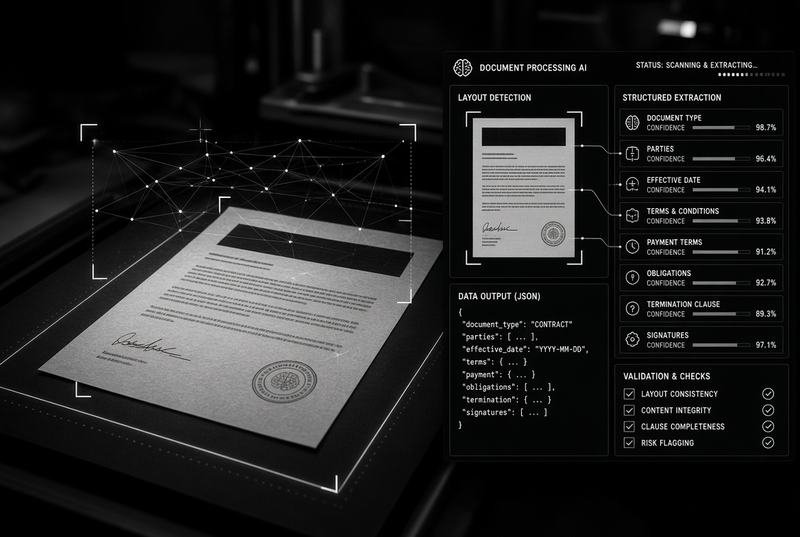
Validation beats extraction
The extraction step is rarely the weak point now. The value is in validation: does this invoice total match its line items, does this supplier exist, is this purchase order still open, is this date plausible? Those checks catch both AI errors and genuine problems in the documents themselves — the second category often surprises clients.
Handling document variety
A hundred suppliers means a hundred invoice layouts. Rather than a template per layout, we use semantic extraction that asks for the concept — supplier, total, due date — and let the model deal with where it sits on the page. New suppliers then work on day one without configuration.
Compliance and retention
Where documents are sensitive, processing can run entirely inside your infrastructure, with retention rules, redaction of fields you do not need, and an audit trail of who saw what.
Frequently asked questions
How accurate is it?
On clean digital PDFs, field-level accuracy above 95% is normal. On poor scans and photographs it is lower, which is exactly why confidence scoring and review queues exist. We measure accuracy on your documents during a pilot rather than quoting someone else's benchmark.
Can it handle handwriting?
Printed handwriting reasonably well, cursive less reliably. If handwriting is central to your process, we pilot on your real documents before you commit to anything.
What about documents in other languages?
Well supported across major languages, including mixed-language documents, which are common in shipping and trade paperwork.
Can it push data into our system automatically?
Yes, where there is an API or database access. Approved records write straight through; anything below the confidence threshold waits for a person.
Tell us what you are building.
Send a short description of the problem and we will reply within one business day with an honest view of scope, cost and whether we are the right person for it.
Or email directly: contact@hire-ai-dev.com