AI agent development
An agent is software that plans a task, uses tools to carry it out, and reports what it did. We build agents that do useful work inside real businesses — with limits, logging and a stop button.
What this involves
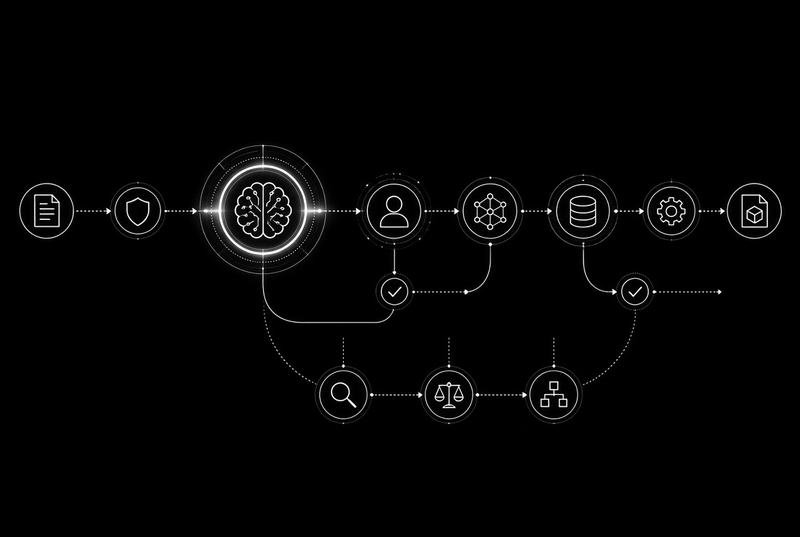
Most agent projects fail for the same reason: they are given freedom without supervision. An agent that can take twenty actions can take twenty wrong actions. Every agent we build has an explicit list of tools it may use, a hard cap on steps and cost, and a full trace of what it did.
Where a decision carries real consequence — sending money, emailing a customer, deleting records — the agent pauses and asks a person. That single design choice is what separates an agent teams actually keep running from one quietly switched off after a month.
- Tool and function calling against your existing APIs
- Step limits, cost ceilings and timeout handling
- Human approval gates on consequential actions
- Full run traces you can read and replay
- Retry and fallback logic when a tool fails
- A dashboard for watching and stopping live runs
Where agents genuinely help
The best fit is a task with clear steps, clear success criteria and a lot of repetition: triaging inbound tickets, enriching CRM records from public sources, reconciling two systems that disagree, monitoring a feed and drafting a response for review.
The worst fit is anything with an ambiguous goal or a very high cost of error and no reviewer. For those, a single well-designed prompt with a person in the loop beats an autonomous agent every time, and we will tell you so before taking your money.
How we build them
We start with the tools, not the model. Each capability the agent needs becomes a small, tested function with a strict input and output contract. The agent can only act through those functions, which makes the whole system auditable and testable.
Then comes the evaluation set — twenty to a hundred real tasks with known good outcomes. Every change to the prompt or the tools is measured against it, so you find out that a change made things worse before your customers do.
What you receive
Source code in your repository, deployed to your cloud account, with runbooks for the failure modes We found in testing. No hosted black box that stops working when we stop answering email.
The three failures that end agent projects
The first is the unbounded loop. An agent with no ceiling and a task it cannot complete will keep trying, and every attempt costs money. Every agent we build has a hard limit on steps, on wall-clock time and on spend, enforced outside the model's own judgement — because a model asked to decide whether it should stop is not a reliable judge of that.
The second is silent tool failure. When a tool returns an error the model does not understand, it frequently carries on as though the call succeeded, and a confident wrong answer arrives downstream. Tools return structured, explicit failures, and the agent is built to halt rather than improvise around them.
The third is the missing trace. When an agent does something wrong and nobody can reconstruct which tools ran, in what order, with what inputs, debugging becomes guesswork. Tracing is not observability polish here; it is the only route to improving the system.
Tool design is most of the work
Agent reliability is mostly tool reliability. A tool with eight optional parameters and a vague description will be called incorrectly, and no amount of prompt engineering fixes that. One tool, one job, two arguments, and a description written for a competent stranger.
Return values matter as much as inputs. We give back the smallest useful result rather than a raw API response, because every irrelevant field is context spent on nothing and another chance to misread. Failures are unambiguous: “no customer found with that ID” is usable, a stack trace is not.
Where a person stays in the loop
Any action that moves money, contacts a customer, changes a record or cannot be undone pauses for approval. The approval screen shows what the agent intends to do, why, and what it read to decide — not a yes/no prompt with no context behind it.
This is the design choice that separates agents teams keep running from the ones quietly switched off after a month. It also makes the system auditable, which matters the first time somebody asks why a particular action was taken.
When we will tell you not to build one
If the sequence of steps is known in advance, an agent is the wrong shape. A workflow with model calls at fixed points is cheaper to run, faster, easier to test and far easier to debug at three in the morning.
Agents earn their complexity when the path genuinely varies with the input and the branching is too wide to write down. That is a narrower set of problems than the current enthusiasm suggests, and we would rather say so in week one.
Frequently asked questions
How is an agent different from a chatbot?
A chatbot answers. An agent acts. A chatbot can tell your customer their order is delayed; an agent can look up the order, check the courier API, issue a credit within a policy limit and write the email — then log every step it took.
How do you stop an agent doing something expensive or wrong?
Four layers: a whitelist of tools it may call, a hard cap on steps and spend per run, approval gates on any consequential action, and a full trace with a kill switch. Anything that touches money, customers or deletion goes behind human approval by default.
How long does an agent project take?
A single-purpose agent with two or three tools takes roughly three to five weeks including evaluation. Multi-agent systems or agents touching many internal systems take eight weeks or more, mostly because of integration work rather than the AI itself.
Which models do you use?
Whichever performs best on your evaluation set at an acceptable cost and latency. We build behind a provider-agnostic interface so you can switch models without a rewrite — model quality and pricing move too fast to hard-wire one choice into your product.
Tell us what you are building.
Send a short description of the problem and we will reply within one business day with an honest view of scope, cost and whether we are the right person for it.
Or email directly: contact@hire-ai-dev.com